Building 11th Edition support: smart scoring, asymmetric primaries & a full hand
The 11th edition rules changed a lot about how a competitive game is scored. Players pick a force disposition before the game, the two players can be on different primary missions, and secondaries go into a hand that you keep between rounds. Our scoring engine was built for 10th edition and could not handle any of that.
So we rebuilt it in a few weeks. This post goes through what changed in the game, what we changed in gd streamer, and the problems we ran into.
A new scoring engine
The old engine assumed two things. Both players score the same primary mission, and a secondary is drawn and then scored or discarded in the same round. Neither is true in 11th edition. Your force disposition decides which primaries you can play, and you can keep a secondary in your hand for a later round.
That meant the data model, the tablet input and the overlays all had to change together. We started with the cards, because that is the part players actually touch during a game.
Redesigning the secondary cards
A card needs to be readable on a 21 inch tablet, in a 1080p overlay, and on stream from across the table. We settled on a field manual style: a coloured header with the mission name, scoring blocks labeled FIXED in burnt orange or TACTICAL in ink blue, and a square VP chip next to every condition. The idea is that you can find the points without reading the whole card.
All 34 secondary cards were redrawn in this one template, so a card looks the same on the tablet as it does in the corner of a broadcast.
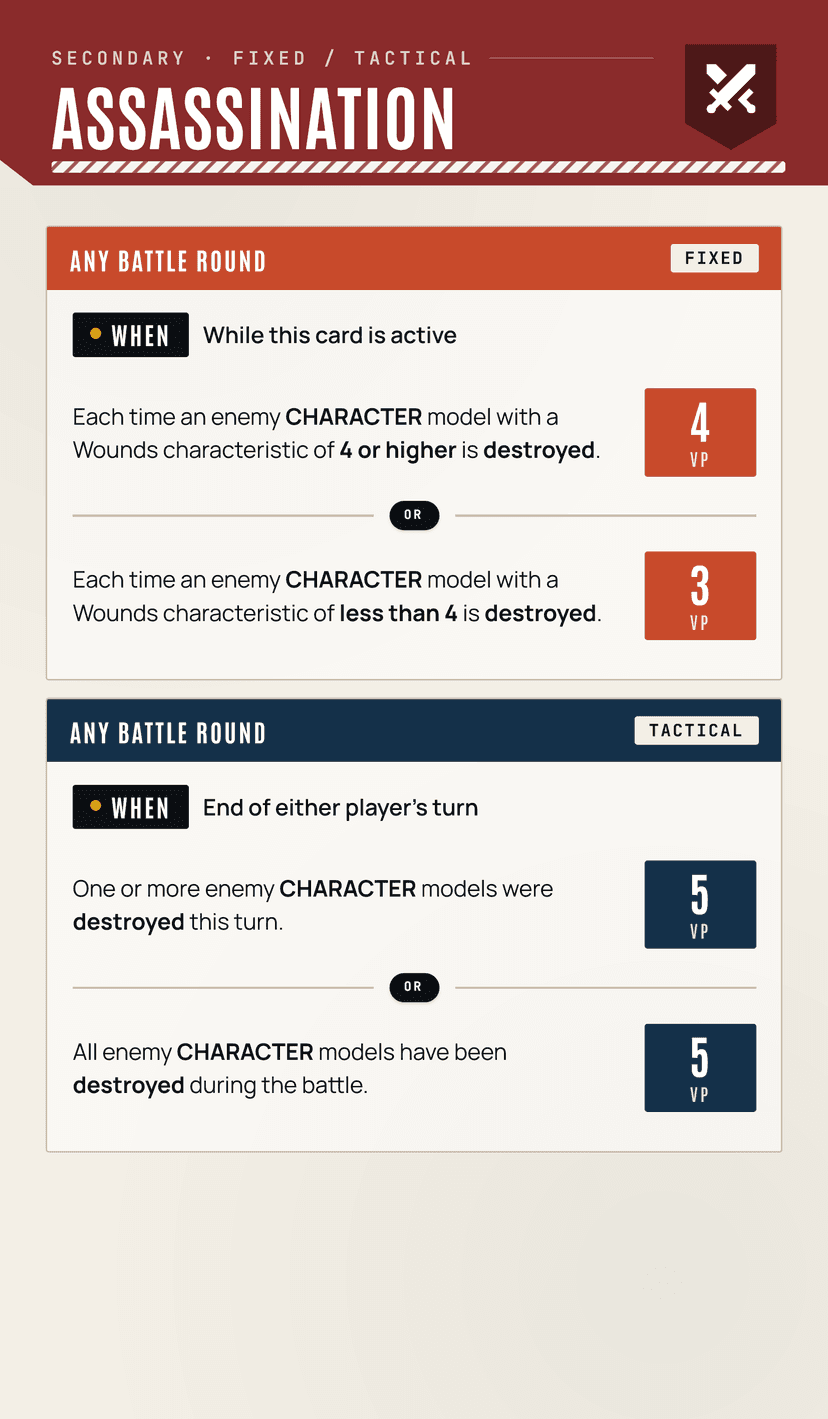
One of the 34 secondary cards we redrew for the tablet, the overlays, and the stream.
Scoring from the card
In 10th edition you scored a secondary by tapping +1 or −1 until the total was right. That is slow, and during a live event players forget to do it. The overlay then shows old numbers and viewers notice.
In 11th edition the scoring conditions on a card are buttons. The player taps the condition that happened, confirms it, and the score is in. The total is capped automatically and the overlay updates right away.
A full hand on the tablet
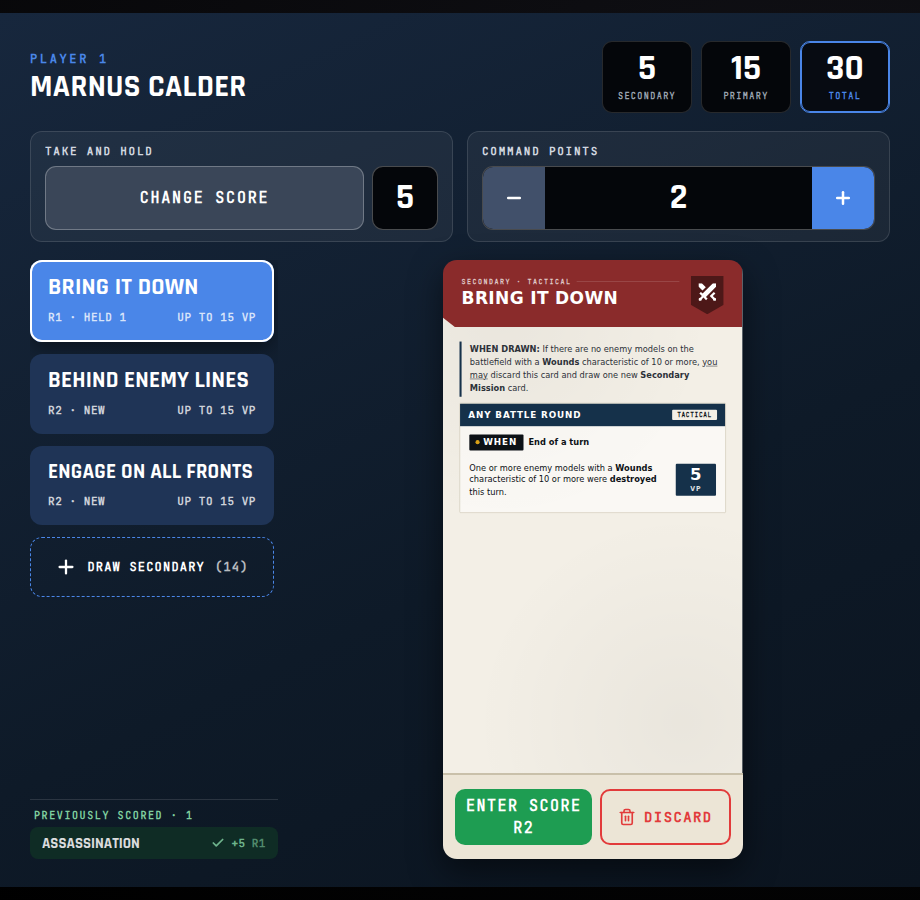
This was the biggest change. In 11th edition you keep secondaries in your hand instead of discarding what you did not score. The old tablet interface could show two cards at most, and in 11th edition a hand can grow to eight.
We rebuilt the tablet around the hand. Your cards are listed on your side of the screen with the round they were drawn in and their status. Tapping a card opens it, and from there you can score it, keep it, or discard it. The screen is still split, blue for player 1 on the left and red for player 2 on the right, and each side manages its own hand.
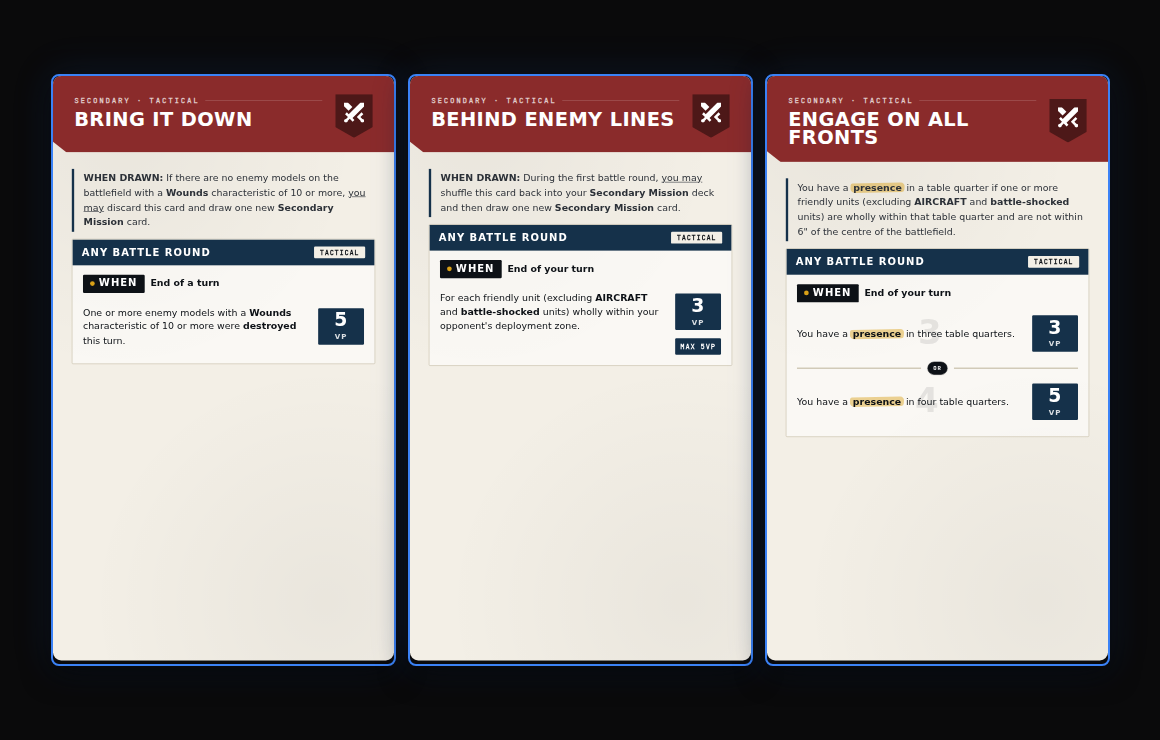
More than two secondaries in the overlays
Our 10th edition overlays assumed a player holds at most two secondaries. In 11th edition a player can easily be holding three or four, and viewers want to see all of them with their current VP.
The scoreboard now grows with the hand. We spent a lot of time making sure the numbers stay readable and the layout does not break when a hand gets big.
Asymmetric primaries
In many 11th edition games the attacker and the defender play different primary missions. The old scoreboard showed one shared primary for both players, so that had to go.
Each player now has their own primary and their own progress on the scoreboard, and the overlay no longer assumes the two match.
The force disposition matrix
The force disposition is picked before the game starts: Take and Hold, Purge the Foe, Reconnaissance, Priority Assets, or Disruption. Your choice decides which primaries are available to you. We added the selection grid to the game setup page, and the overlays can show which disposition a player picked, so viewers understand what each player is trying to do.
Where it stands
11th edition support is complete. Every mission is in, and you can run a full match today, from force disposition to scoring secondaries straight off the card. What is left is polish, and we are iterating on that.
If you stream 11th edition with it, let me know what can be better. That feedback is how the 10th edition support got to where it is.
Ron